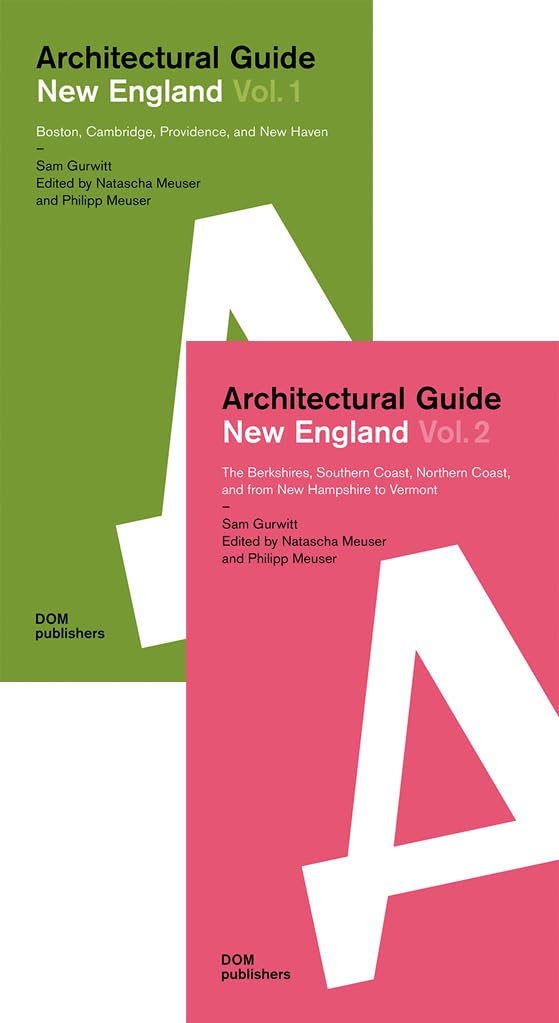
New England Architectural Guide: Vol. 1: Boston, Cambridge, Providence, and New Haven; Vol. 2: The Berkshires, Southern Coast, Northern Coast, and
$59.95
by Sam Gurwitt



250 years of the United States of America Two volumes, one region: from Boston’s civic and academic institutions to coastal landscapes and post-industrial sites, this 650-page title maps the full spectrum of the built environment in Connecticut, Maine, Massachusetts, New Hampshire, Rhode Island, and Vermont. More than 500 buildings by famous architects such as Marcel Breuer, Charles Bulfinch, Philip Johnson, Louis Kahn, I. M. Pei, Paul Rudolph, Josep Sert, among others. Since independence began here, New England has developed into a laboratory of American architecture, where civic order took on a permanent form. Volume 1 of the Architectural Guide New England focuses on the region’s urban and institutional centers, stretching from Boston to New Haven. It examines those places where architecture developed as a cultural practice, an academic discipline, and a framework for social order. The volume traces the development of key building types, from the meeting house and the state house to the university campus, and shows how European architectural models were transformed into distinct local traditions. Architecture is not presented as a sequence of styles, but as a continuous discourse. Particular attention is given to the roles of schools and professional networks in establishing New England as a formative center of American architectural culture. The almost 250 buildings in this volume discussed demonstrate how the principles of restraint, proportion, and durability became guiding forces whose influence extended far beyond New England. Volume 2 of the Architectural Guide New England examines those regions where building is closely tied to the surrounding landscape. Coastal regions, rural areas, former industrial sites, and islands provide the framework for an architectural history shaped less by institutional concentration than by topographical conditions. The focus mainly lies on questions of adaptation and continuity: adaptive reuse, tourism-related architecture, seasonal buildings, and cultural and religious sites outside of metropolitan centers. The more than 250 buildings in this volume show how architectural concepts are carried forward, modified, or reinterpreted under different social and spatial conditions. In this way, it complements the institutional perspective of Volume 1 with a broader interpretation of the region. Sam Gurwitt (born 1996) is a writer, journalist, and translator. He grew up in Vermont and spent formative years in New Haven. His work has focused on architecture, urban history, and the social contexts of the built environment. He studied history at Yale University, where he explored architectural culture on both sides of the Atlantic. In 2021, he move to Germany on a Fulbright grant to research the legacy of East Germany’s mass housing program in Leipzig. He is the author of the two-volume Architectural Guide New England. Dietrich Neumann (born 1956) is the Christopher Chan and Michelle Ma Professor of the History of Art and Architecture at Brown University in Providence, Rhode Island, and former Director of the John Nicholas Brown Center for Public Humanities and Cultural Heritage. Trained as an architect and historian in Munich and London, he has held visiting professorships at Yale University, the University of Porto and the Chinese University of Hong Kong. His research focuses on building types and materials, architectural illumination, film sets, and the work of Ludwig Mies van der Rohe. He is the co-author of the section on Providence in the Architectural Guide New England. Natascha Meuser (born 1967) is a German architect, professor, and publisher based in Berlin, working at the intersection of practice, teaching, and architectural publishing. From 1991 to 1993, she studied at the Illinois Institute of Technology in Chicago, where she worked in the academic environment shaped by Helmut Jahn. She taught architecture in Dessau, Germany, for many years, including courses in interior design and architectural drawing, and consistently worked to foreground women architects. She is active as an architect on international and overseas projects, and is co-founder of DOM publishers (with Philipp Meuser). Philipp Meuser (born 1969) is a German architect, architectural historian, and publisher based in Berlin, combining practice, research, and editorial work. He completed his first architectural internship in 1992 in Atlanta, Georgia, gaining early professional experience in the United States. During his visiting professorship at Brown University (2022), he initiated the Architectural Guide New England together with Natascha Meuser. He is active as an architect on international and overseas projects with a special focus on crisis regions. Honorary professorships in Ukraine and Uzbekistan underscore his commitment to international cultural exchange.